
Center for Asia-Pacific Studies (CAPS)

Center for Asia-Pacific Studies (CAPS)

About Us

CEVRO - CAPS_EN.png

Center for Asia-Pacific Studies (CAPS) at CEVRO University focuses its activities, mission, and outputs on key topics and areas within the Asia-Pacific region. In addition to academic work, it engages in popular-science activities, aims to shape public debate, and provides expert support to Czech public institutions and the private sector. The applicability and practical relevance of its outputs in relation to the Czech national interest is a top priority. As such, the Center provides considerable added value both within the Czech Republic and globally.


CAPS Mission

The Center’s main objective is to focus on understanding the political and economic specifics of the Asia-Pacific region in their full complexity and to address the growing demand from both the public sector and the business community.


CAPS Goal

Our aim is to establish a high-quality research hub — a true center of excellence — focused on Asia-Pacific issues. At the same time, the center is designed to engage in popular-science outreach, shape both domestic and global public discourse, and offer expert support to Czech public institutions and private entities, with a strong emphasis on advancing the Czech national interest. We thus strive to become a recognized and respected partner for all stakeholders engaged with the region.

Message from the Director

jan_zelezny_cevro_talks.jpgOver the past few decades, the Asia-Pacific region has transformed from a relatively overlooked area into a geopolitical hotspot and a major driver of the global economy. Its significance in world politics, economics, and other spheres cannot be underestimated. However, the Czech domestic debate remains markedly Sinocentric, often placing less emphasis on other key players and associated topics within the region.
This focus on China is understandable. China is a global economic powerhouse with increasing geopolitical influence and serves as a central actor in various multilateral frameworks — particularly economic and security-oriented ones — such as the Regional Comprehensive Economic Partnership (RCEP), the Belt and Road Initiative (BRI), or the Shanghai Cooperation Organization (SCO). Taiwan, meanwhile, has emerged as a global hub for advanced technologies, especially artificial intelligence (AI), which is powering the current stage of the Fourth Industrial Revolution.

Nonetheless, this approach is also limiting, as it overlooks other significant actors. These include established middle powers and some of the world’s most advanced economies, such as Japan and South Korea. Their leadership in technology, innovation-driven cultures, emphasis on foreign investment, and — in the case of South Korea — deepening strategic cooperation with the Czech Republic in energy, make them highly relevant non-European partners for Czech business and institutions alike.

It is also crucial to consider the growing importance of the region’s emerging leaders — often labeled “Asian Tigers” or “Asian Dragons” — such as Indonesia, Malaysia, Vietnam, and other ASEAN members. These countries are actively shaping the global stage through their economic and geopolitical trajectories. India stands out even more prominently, having positioned itself in recent years through its “Act East” policy and participation in forums like the G20. India is increasingly seen not only as a voice of the “Global South” but also as a key pole in the emerging multipolar world order.

We must not overlook Central Asian countries, particularly Kazakhstan. With their “multi-vector” foreign policies (also referred to as “all-azimuth” strategies), they maintain active relations with Russia (their so-called “near abroad”), participate in China’s Belt and Road projects, and engage with EU states. Their strategic location as transport hubs and rich deposits of critical raw materials make them vital global actors. All these countries are dynamically developing economies that are benefiting from Western strategies like decoupling, derisking, and “China Plus One” — presenting new business opportunities for European nations, including the Czech Republic.

The activities of the Center for Asia-Pacific Studies (CAPS) are therefore focused on understanding the political and economic complexities of this region — including, for example, so-called “bamboo diplomacy.” Our goal is to create a top-tier research center while also engaging in educational outreach, shaping public discourse, and providing expert support to Czech public institutions and businesses. Practical applicability and alignment with Czech national interests are our key priorities. Ultimately, the Center aims to contribute significant value within both the Czech and global arenas.

Jan Železný, Ph.D., Executive Director

CAPS Members

Zahradil - foto.jpeg

Jan Zahradil
Chairman of the Advisory Board / Senior Advisor / Founder

Jan Zahradil began his political career in 1992 as a member of the Federal Assembly of Czechoslovakia. After the dissolution of Czechoslovakia, he served as an advisor to the Prime Minister of the Czech Republic. In 1998, he was elected as a member of the Chamber of Deputies of the Czech Parliament. Following the Czech Republic’s accession to the European Union in 2004, he became a Member of the European Parliament (MEP), where he served until 2024 — making him the longest-serving Czech MEP. From 2010 to 2020, he was the President of the European Conservatives and Reformists (ECR). In the 2019 European elections, he was nominated by the ECR as their Spitzenkandidat (lead candidate) for President of the European Commission — the first-ever candidate from Eastern Europe endorsed by a European political group.

During his tenure, he was a member and later First Vice-Chair of the European Parliament’s Committee on International Trade and acted as rapporteur for the EU-Vietnam Free Trade Agreement and for the EU’s Indo-Pacific trade and investment strategy. As an expert on EU-Asia relations, he has travelled and lectured widely throughout the region — visiting countries such as China, Vietnam, Cambodia, Thailand, Singapore, Malaysia, Indonesia, South Korea, India, Japan, Pakistan, Nepal, Sri Lanka, Australia, and New Zealand.

He also co-chairs the Asia-Europe Political Forum of the International Conference of Asian Political Parties (ICAPP), which brings together ruling and opposition parties from dozens of Asian countries.


Chung Eui-yong (1).jpeg

Chung Eui-yong
Member of the Advisory Board

Chung Eui-yong is a South Korean diplomat and politician who served as Minister of Foreign Affairs of the Republic of Korea from 2021 to 2022. Earlier, from 2017 to 2020, he was the first Director of the National Security Office under President Moon Jae-in.

After graduating from Seoul National University in 1968, he joined the Ministry of Foreign Affairs in 1971. He later served as Ambassador of the Republic of Korea to Israel (1997–1998), Deputy Minister for Trade (1998–2001), and Ambassador to the Permanent Mission of the Republic of Korea to the United Nations Office and other international organizations in Geneva (2001–2004).

In 2004, he was elected to the 17th National Assembly and subsequently served as Secretary-General of the International Conference of Asian Political Parties (ICAPP).

In 2017, newly inaugurated President Moon Jae-in appointed him Director of the National Security Office at ministerial level. In July 2020, he was reassigned as Special Adviser to the President for Foreign Policy, Diplomacy, and National Security. In 2021, he became South Korea’s Minister of Foreign Affairs, a post he held until 2022.


george_yeo.jpg

George Yeo
Member of the Advisory Board

From September 1988 to May 2011, George Yeo served for 23 years in the Government of Singapore. During this period, he held the positions of Minister for Information and the Arts, Minister for Health, Minister for Trade and Industry, and Minister for Foreign Affairs.

Mr Yeo studied Engineering at the University of Cambridge on a President’s Scholarship, graduating in 1976 with a Double First. He subsequently became a Signals Officer in the Singapore Armed Forces. After completing the Singapore Command and Staff College in 1979, he was posted to the Republic of Singapore Air Force.

From 1985 to 1986, he was appointed Chief of Staff of the Air Staff, and between 1985 and 1988 he served as Director of Joint Operations and Planning at the Ministry of Defence. He attained the rank of Brigadier-General.

From 2013 to 2014, he was a member of the Pontifical Commission for Reference on the Economic-Administrative Structure of the Holy See, and from February 2014 to July 2020 he served on the Vatican Council for the Economy.


marina_saikh.jpeg

Marina Shaikh
Member of the Advisory Board

Marina Shaikh is a philanthropist, influencer, and the founder of The Rising World Foundation (RWF), an organization dedicated to supporting vulnerable communities in India. Her work focuses in particular on empowering women and providing essential healthcare, and has contributed to a range of positive social changes. Under her leadership, RWF has delivered food assistance, essential ration kits, and medical supplies, including oxygen concentrators during the COVID-19 pandemic.

Marina began her career in Brussels as a special assistant to former Member of the European Parliament Nirj Deva, and later served as Director General for India at Alliance of Conservatives and Reformists in Europe (ACRE). Her international experience significantly shaped her philanthropic activities, which she brought back to India through the founding of RWF.

For her humanitarian work, she has received recognition from prestigious media outlets such as The Times of India and The Free Press Journal, as well as awards from the Governor of Kerala and other distinguished institutions.

Born in Indore, she is a graduate of National College Mumbai. Her work continues to inspire positive change and serves as a beacon of hope for those most in need.


vit_vojta.jpg

Vít Vojta
Member of the Advisory Board

A sinologist, ethnologist, and lawyer with thirty years of experience in economic and legal advisory services focused on Asian markets, including China and Southeast Asia. He provides strategic consulting and intercultural management to leading corporations in Central and Eastern Europe, such as Škoda Auto, VW Group, Robert Bosch, and PPF Group. For more than two decades, he has served as an interpreter into Chinese for top state representatives during official visits and international summits.

Selected Publications:

  • A series of articles and essays covering topics ranging from intercultural communication and business strategy to the history and thought of Eastern civilizations (e.g. www.asiaskop.cz, https://www.echo24.cz/author/vit-vojta).
  • The Regional Comprehensive Economic Partnership (RCEP) in the Context of Asian Integration and Its Influence on the European Union. VIT Consulting, Prague, 2022. Co-authored.
  • Between East and West: Communication and Dining with Chinese Partners. VIT Consulting, 2018. 104 pp.
  • Sun Tzu’s The Art of War: The Use of Military Strategies in Business. BizBooks, 2014–2025 (3rd edition).
  • The Chinese World. Pixl-e, 2011. 200 pp.
  • The Art of Taijiquan. Vodnář, Prague, 2001. 159 pp.


jan_zelezny_cevro_talks.jpg

Jan Železný, Ph.D.
Executive Director

jan.zelezny@cevro.cz

Jan Železný serves as Executive Director of the Center for Asia-Pacific Studies (CAPS) and as an Assistant Professor at the Department of Political Science and International Relations at CEVRO University in Prague. He is a graduate of the bachelor’s degree program in Political Science and the master’s degree program in International Relations at the Faculty of Arts of the University of West Bohemia in Pilsen, where he also completed his doctoral studies (Ph.D.) in International Relations. His research focuses on transformations of the international order, power competition between the United States, China, and other major powers in the Asia-Pacific region and the Arctic, astropolitics (the geopolitics of outer space), and the geopolitics of the Fourth Industrial Revolution.

He regularly participates in international conferences such as the British Association for Chinese Studies (BACS) and the Joint East Asian Studies Conference (JEASC), held at prestigious universities including Oxford and King's College London. He is also involved in international research teams and contributed chapters to Routledge Handbook of Chinese and Eurasian International Studies (2024) and Routledge Handbook of China’s Belt and Road Initiative in Eurasia (2025).

He is a frequent contributor to Czech media outlets including Info.cz, E15, and Týden.cz. In the past, he worked in the Czech Chamber of Deputies as a parliamentary assistant and foreign policy advisor. He speaks English and Russian and is learning German and Spanish.

Research Interests:

  • Formation of international order and great power strategies (hedging focus)
  • U.S.-China-India relations in the Asia-Pacific
  • Space geopolitics (focus on China and Russia)
  • Arctic geopolitics and great power competition
  • Geopolitics of the 4th Industrial Revolution (advanced chip supply chains)

Selected Publications:

  • Železný, Jan – Michlmayr, Timna (2025): China’s Starry Constellations with Russia and the Global South: The Space Silk Road Analysed. In: Sahakyan, Mher (ed.): Routledge Handbook of China’s Belt and Road Initiative in Eurasia. Routledge. London.
  • Železný, Jan (2024): The Dragon and the Bear on the Polar Silk Road – The Analysis of the China-Russia Cooperation in the Arctic and Its Impact on the Great-Power Competition in the High North. In: Sahakyan, Mher (ed.): Routledge Handbook of Chinese and Eurasian International Relations. Routledge. London.
  • Železný, Jan (2022): More than just hedging? The reactions of Cambodia and Vietnam to the power struggle between the United States and China in times of Obama’s „pivot to Asia“. Asian Politics and Policy. Vol. 14, No. 2, pp. 216–248.


zdenek_rod.jpg

Zdeněk Rod, Ph.D.
Senior Fellow / Head of Research

zdenek.rod@cevro.cz

Zdeněk Rod has been an assistant professor at the Department of Security Studies at CEVRO University since 2025. He is also a Visiting Fellow at the John Lukacs Institute for Strategy and Politics (University of Public Service, Budapest) and Co-Director of the Center for Security Consulting. He earned his Ph.D. in International Relations at the University of West Bohemia (2024) and has studied in Ljubljana, Budapest, and at the European Security and Defence College in Brussels.

He previously worked at the Czech Ministry of Defence and published extensively in journals and books from Oxford University Press, Taylor & Francis, Wiley, Routledge, and Palgrave Macmillan. His commentaries appear in RAND Corporation, SAIS Review of International Affairs, Defence News, and The Diplomat.

Research Interests:

  • International and national security
  • Strategic communication
  • China in international relations

Selected Publications:

  • Rod, Zdeněk eds. (2025). Navigating the Silk Road in Central and Eastern Europe. In: Mher Sahakyan – Kevin Lo, Routledge Handbook of China’s Belt and Road Initiative in Eurasia (London: Routledge).
  • Rod, Zdeněk (2025). From Promises to Perils: Unpacking China’s Interference in the Visegrad Group. In Lucie Tungul, Battle for Democracy in the Digital Age (Brussells: Wilfried Martens Centre for European Studies): p. 87–97.
  • Rod, Zdeněk eds. (2025). Ten years of the Belt and Road Initiative: What’s changed? Observing China. Council on Geostrategy (https://www.observingchina.org.uk/p/the-tangram-03-2025).
  • Rod, Zdeněk (2024). Debt or Diplomacy? Inside China’s Controversial Loans to Sri Lanka, Laos, and Malaysia. The Diplomat, 5. 10. 2024 (https://thediplomat.com/2024/10/debt-or-diplomacy-inside-chinas-controversial-loans-to-sri-lanka-laos-and-malaysia/).
  • Rod, Zdeněk – Himmer, Michal (2023). Chinese debt trap diplomacy: reality or myth? Journal of the Indian Ocean Region, Vol. 18. No. 3, pp. 250–272.
  • Rod, Zdeněk (2023). The Chinese Influence in Visegrad Countries, in: Andrea Bogoni and Brian F. G. Fabrègue, eds., The Dragon at the Gates of Europe: Chinese Presence in the Balkans and Central-Eastern Europe, Blue Europe, Dec 2023: p. 273-298.
  • Rod, Zdeněk – Himmer, Michal (2021). The Great Powers’ Competition in Central America. The Response of the U.S. to Chinese Activities in the Region. Latin American Policy, Vol. 12, No. 2, pp. 236–249.
  • Rod, Zdeněk – Himmer, Michal (2020). The Motivation of Diplomatic Switch of Selected States Newly Recognizing China Within the China-Taiwan Rivalry. Czech Journal of International Relations, Vol. 55, No. 3, pp. 50–68.


roman_kodet.jpg

Roman Kodet, Ph.D.
Senior Fellow

He serves as a university lecturer at the Department of Historical Sciences, Faculty of Arts, University of West Bohemia in Plzeň. His research focuses on the history of Japan, international politics, and military history of the 19th and 20th centuries. He studied history at the Faculty of Arts, Charles University, where he defended his dissertation on the relations between Austria-Hungary and the Ottoman Empire (2012). Since 2009, he has been teaching at the University of West Bohemia, where he founded the Center for Japanese Studies in 2018.

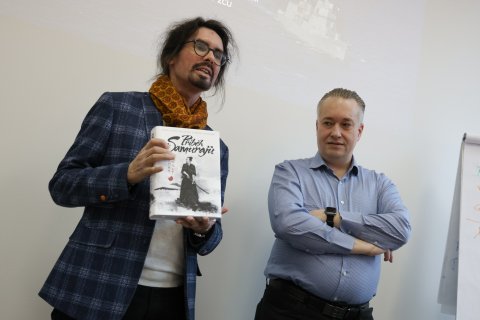
He is the author of numerous scholarly and popular works. Among his most significant publications are the monographs Wars of the Samurai (2015), The Story of the Samurai (2018; second edition 2024), and The Twilight of the Samurai(2024). His works have earned him the Miroslav Ivanov Award three times. He also serves as Executive Editor of the West Bohemian Historical Review and, in 2021, led a project supported by the Japan Foundation.

Selected Publications:

  • KODET, Roman, The Japanese Invasion of Formosa, 1874, in the Context of the International Relations in the Far East. In: The International History Review 47, 2025, s. 1–18.
  • KODET, Roman, First British Travelers and Residents in Japan: Sources and Perspectives of Research. In: Zbornik radova Filozofskog fakulteta u Splitu/ Journal of Faculty of Humanities and Social Sciences in Split 17, 2024, pp. 161–178.
  • KODET, Roman, Soumrak samurajů. Válka, velmoci, revoluce a vznik moderního Japonka (1850–1880), Praha 2024.
  • KODET, Roman, Příběh samurajů. Život a svět válečníků starého Japonska, Praha 2018.
  • SKŘIVAN, Aleš Sr., SKŘIVAN, Aleš Jr., NOVOTNÝ, Lukáš, KOČVAR, Jan, KODET, Roman, Hra o Říši středu. Politické a hospodářské zájmy Velké Británie a Německa v Číně, 1894–1914, Praha 2017.


daniela_finkousova.jpeg

Daniela Finkousová
Junior Fellow

daniela.finkousova@cevro.cz

Daniela Finkousová is a Junior Fellow at CAPS. She holds a BA in Political Science and International Relations from CEVRO University and is completing her MA in Political Science and postgraduate MPA in Modern Public Administration. Since 2024, she has worked in the Czech Chamber of Deputies as a parliamentary assistant, focusing on legislative analysis and amendment drafting, social media management, and event coordination. She previously worked at think tank e-Stat.cz and completed an internship at the Ministry of Industry and Trade.

She contributes to CEVRO Arena, Pravý břeh, and Forum 24, and her focus includes U.S. foreign policy, Asia-Pacific security dynamics, and hybrid threats. She speaks English and German.

Research Interests:

  • U.S. foreign/domestic policy (focus on “Trumpism”)
  • Strategic competition in Asia-Pacific
  • Hybrid and cyber threats


jan_vavrik.JPEG

Jan Vavřík
Junior Fellow

Jan Vavřík is a Junior Fellow at CAPS and an analyst for the Security Conference in Pilsen. He produces analytical reports on current international affairs and helps coordinate conferences. He studied International Relations at the University of West Bohemia, focusing on British and American Studies, and later earned a degree in Security Studies.

He has explored the role of technology in global politics — especially blockchain — and his thesis examined the concept of sportswashing. He participated in exchange programs at Osa State University (Kyrgyzstan), University of Dar es Salaam (Tanzania), and Valdosta State University (USA). In 2024, he interned at the Czech Embassy in Seoul. He speaks fluent English and Croatian, with basic knowledge of French, Russian, and Korean.

Research Interests:

  • International security in Asia-Pacific and the transatlantic space
  • Emerging technologies in global governance — especially blockchain


viola_vojtova.jpeg

Viola Vojtová
Office Administrator 

Viola Vojtová is a BA student of Psychology and Management Sociology at the University of Economics and Management (VŠEM). She is particularly interested in intercultural communication and business trends in Europe and Asia. She has gained experience in China and Southeast Asia and has interned in the European Parliament and worked as a business communication trainer for Asian partners. She speaks English, Chinese, and some German.

Science & Research

Publications

Projects and Grants

  • "The Evolution of Czech Foreign Policy towards Indo-Pacific". (2025–present). The project is funded by CEVRO Internal Grant – IGP2025.2026.2.

CAPS Monitoring


CAPS Policy Review

Contact

CEVRO_UNIVERZITA_logo_RGB_01_CEVRO_UNIVERZITA_symbol_brown.jpg

Info CAPS

E-mail: caps@cevro.cz